
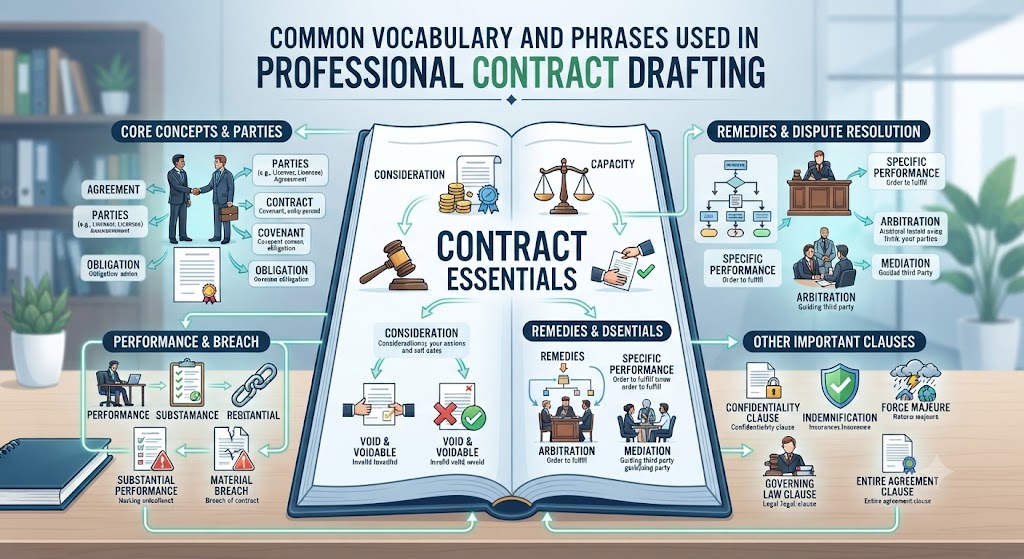
COMMON VOCABULARY AND PHRASES USED IN PROFESSIONAL CONTRACT DRAFTING
Professional contract drafting relies on highly specialised, precise language designed to eliminate ambiguity, allocate risk, and ensure consistency. Modern contract drafting blends traditional "legalese" with clear business English to maximise clarity.
- Contract terminology defines how an agreement works in practice. Key terms establish the parties’ rights, obligations, commercial commitments, risk allocation, and available remedies.
- Contract terms are easier to understand when grouped by function. Looking at agreement structure, performance, pricing, risk, termination, IP, and administration provides context beyond individual definitions.
- Consistency matters across enterprise contracts. Standardised definitions and clause language help teams identify deviations and interpret obligations more reliably across agreements.
- Some terminology carries significant financial and legal implications. Terms covering liability, indemnification, payment, termination, intellectual property, and dispute resolution deserve particular attention.
Professional contract drafting uses precise, consistent, and legally established language. Below is a practical reference guide, particularly useful for drafting commercial agreements, service agreements, lease agreements, joint ventures, NDAs, and business contracts.
1. NAME OF PARTIES:
Party / Parties: Individuals or entities entering into the agreement
First Party / Second Party: Used to distinguish contracting parties
Party of the First Part: Traditional formal terminology
Contracting Parties: Parties entering into contractual obligations
Hereinafter referred to as: Introduces a shortened name for later use
Representatives: Authorised persons acting for a party
Affiliates: Companies/entities connected through ownership or control
Successors and Assigns: Persons/entities legally succeeding to contractual rights
Example: ABC Private Limited, a company incorporated under the Companies Act, 2013, having its registered office at ……. (hereinafter referred to as the “Company”, which expression shall, unless repugnant to the context or meaning thereof, include its successors and permitted assigns).
2. INTRODUCTORY AND BACKGROUND PHRASES:
WHEREAS - Used to introduce background facts.
WHEREAS, the First Party is engaged in the business of ………….
AND WHEREAS - Used for additional background statements.
NOW, THEREFORE - Introduces the operative provisions of the agreement.
NOW, THEREFORE, in consideration of the mutual covenants and promises contained herein, the Parties agree as follows:
Common Expressions: In consideration of, Whereas, Accordingly, Therefore, Pursuant to, In furtherance of, For the purpose of, Subject to, In connection with
3. COMMON OPERATIVE WORDS WITH RIGHTS AND OBLIGATIONS:
Shall - Traditionally used to impose an obligation. Strictly signals a mandatory obligation or a covenant. (e.g., "The Buyer shall pay the Invoice within 30 days.")
May - Indicates discretion or permission. Signals permission or a right, giving the party discretion to perform an action. (e.g., "The Seller - ay terminate this agreement if...")
Must - Expresses a mandatory requirement
Will - Indicates a future event or commitment. Frequently used to state future facts or intentions rather than an enforceable obligation.
Should - Indicates recommendation, not necessarily obligation. Avoided in modern professional drafting as it implies a recommendation rather than a firm obligation
Agrees to - Creates an obligation
Undertakes to - Gives a formal commitment
Covenants to - Makes a contractual promise
Warrants that - Gives an assurance regarding a fact
Represents that - Makes a statement of fact
Acknowledges that - Confirms awareness or acceptance
Example: The Service Provider shall perform the Services with due skill, care and diligence and in accordance with industry standards.
4. FREQUENTLY USED CONTRACT PHRASES:
Subject to - The rights granted herein shall be subject to the terms and conditions of this Agreement.
Notwithstanding anything contained herein - Used to override another provision.
Notwithstanding anything contained herein, either Party may terminate this Agreement in accordance with Clause 10.
Without prejudice to - Protects other legal rights.
Without prejudice to any other rights available to the Company, the Company may terminate this Agreement.
Including but not limited to - Introduces examples without limiting the scope.
Confidential Information includes, but is not limited to, business plans, financial information and customer data.
For the avoidance of doubt - Clarifies a provision.
For the avoidance of doubt, the termination of this Agreement shall not affect accrued rights and obligations.
Mutatis mutandis - Means “with necessary changes having been made.”
The provisions relating to confidentiality shall apply mutatis mutandis to the Affiliates. A Latin phrase meaning "with the necessary changes having been made." Used when applying an existing clause or text to a new scenario without rewriting the details.
5. CONDITIONS AND QUALIFICATIONS:
Common expressions include: Subject to the provisions of this Agreement, In accordance with, In compliance with, To the extent permitted by law, To the extent applicable, As may be amended from time to time, As mutually agreed in writing, Unless otherwise agreed, Unless otherwise specified, Except as otherwise provided, Provided that, Provided however that, In the event that, Upon the occurrence of, Conditional upon.
Example: The payment shall be made within thirty (30) days from the date of receipt of a valid invoice, provided that the services have been satisfactorily performed.
6. REPRESENTATION AND WARRANTY LANGUAGE:
Common expressions: Represents and warrants, Covenants and undertakes, Declares and confirms, Acknowledges and agrees,
Example: Each Party represents and warrants that it has full power and authority to enter into and perform its obligations under this Agreement.
Other useful phrases: Duly authorised, Validly existing, Legally binding, Enforceable obligation, Free and clear of encumbrances, True, complete and accurate, No conflict with applicable law
7. RISK ALLOCATION & LIABILITY PHRASES:
These standard boilerplate phrases determine who pays if things go sideways.
Indemnify and Hold Harmless: A legal triplet where one party agrees to compensate the other for certain losses or damages and protect them from third-party claims.
Limitation of Liability: Caps the financial damages one party can claim from the other if a breach occurs.
Liquidated Damages: A pre-agreed sum of money that the parties agree will be paid as compensation if a specific breach occurs.
Force Majeure: Translates to "greater force." It excuses a party from liability if they cannot fulfil their obligations due to an extraordinary, unforeseeable event (like war, strikes, or natural disasters).
8. CONFIDENTIALITY VOCABULARY: Confidential Information, Proprietary Information, Disclosing Party, Receiving Party, Unauthorised disclosure, Public domain, Need-to-know basis, Reasonable safeguards, Non-disclosure, Non-use, Return or destruction of information
Example: The Receiving Party shall keep the Confidential Information strictly confidential and shall not disclose the same to any third party without the prior written consent of the Disclosing Party.
9. PAYMENT AND FINANCIAL TERMS:
Common vocabulary: Consideration, Fee, Charges, Remuneration, Compensation, Invoice, Payment due date, Outstanding amount, Overdue amount, Interest, Taxes and duties, Withholding tax, Reimbursement, Non-refundable, Advance payment.
Useful phrases: The consideration payable under this Agreement shall be __________.
All applicable taxes shall be borne by __________.
Payments shall be subject to applicable deductions and withholding taxes.
10. INDEMNITY LANGUAGE:
Common words and phrases: Indemnify, Defend, Hold harmless, Claims, Losses, Damages, Liabilities, Costs and expenses, Legal expenses, Third-party claims. A legal triplet where one party agrees to compensate the other for certain losses or damages and protect them from third-party claims.
Example: The Indemnifying Party shall indemnify, defend and hold harmless the Indemnified Party from and against all claims, losses, damages, liabilities, costs and expenses arising out of or in connection with __________.
11. LIMITATION OF LIABILITY:
Frequently used expressions: Direct damages, Indirect damages, Consequential damages, Incidental damages, Special damages, Loss of profits, Aggregate liability, Liability cap, Exclusion of liability. Caps the financial damages one party can claim from the other if a breach occurs.
Example: Neither Party shall be liable for any indirect, incidental, special or consequential loss or damage, including loss of profits or business opportunities.
12. TERM AND TERMINATION:
Common vocabulary: Effective Date, Commencement Date, Initial Term, Term, Renewal Term, Expiry, Termination, Termination for convenience, Termination for cause, Material breach, Notice period, Cure period.
Example: Either Party may terminate this Agreement by giving thirty (30) days' prior written notice to the other Party.
Termination for breach - In the event of a material breach of this Agreement, the non-defaulting Party may terminate this Agreement if such breach is not cured within fifteen (15) days of receipt of written notice.
13. NOTICE CLAUSE:
Common phrases: Notice in writing, Written communication, Registered post, Courier, Electronic mail, Deemed delivery, Notice address.
Example: Any notice under this Agreement shall be in writing and shall be deemed duly delivered if sent by registered post, reputable courier service or electronic mail to the address specified herein.
14. FORCE MAJEURE:
Important vocabulary: Force Majeure Event, Beyond reasonable control, Natural disaster, War, Riot, Pandemic, Government action, Act of God, Impossibility of performance, Suspension of obligations. Translates to "greater force." It excuses a party from liability if they cannot fulfil their obligations due to an extraordinary, unforeseeable event (like war, strikes, or natural disasters).
Example: Neither Party shall be liable for any failure or delay in performing its obligations to the extent such failure or delay is caused by a Force Majeure Event.
15. DISPUTE RESOLUTION:
Common terms: Amicable settlement, Negotiation, Mediation, Conciliation, Arbitration, Arbitral Tribunal, Sole Arbitrator, Jurisdiction, Governing law, Seat of arbitration, Venue.
Example: Any dispute arising out of or in connection with this Agreement shall first be resolved amicably through mutual negotiations.
16. GOVERNING LAW & JURISDICTION: Establishes which state or country's laws will apply to the contract, and which court has the right to resolve disputes.
Typical wording:
This Agreement shall be governed by and construed in accordance with the laws of India.
The courts at …………. shall have exclusive jurisdiction over all matters arising out of or relating to this Agreement.
17. ASSIGNMENT & TRANSFER:
Common phrases: Assign, Transfer, Delegate, Sub-contract, Prior written consent, Permitted assigns.
Example: Neither Party shall assign or transfer any of its rights or obligations under this Agreement without the prior written consent of the other Party.
18. ENTIRE AGREEMENT CLAUSE:
This Agreement constitutes the entire agreement between the Parties with respect to the subject matter hereof and supersedes all prior discussions, negotiations, representations and agreements. Entire Agreement / Integration Clause: Declares that this text represents the final and complete agreement, overriding all previous verbal or written discussions.
Useful vocabulary: Entire understanding, Supersedes, Prior agreements, Oral or written, communications.
19. AMENDMENT & WAIVER:
Amendment - No amendment or modification of this Agreement shall be valid unless made in writing and signed by duly authorised representatives of both Parties.
Waiver - No failure or delay by either Party in exercising any right shall constitute a waiver of such right.
20. SEVERABILITY:
If any provision of this Agreement is held to be invalid, illegal or unenforceable, the remaining provisions shall continue in full force and effect. Severability states that if a court finds one specific clause invalid or illegal, the rest of the contract remains enforceable.
21. SURVIVAL CLAUSE:
The provisions relating to confidentiality, indemnity, limitation of liability and dispute resolution shall survive the termination or expiry of this Agreement.
22. COUNTERPARTS & ELECTRONIC EXECUTION:
This Agreement may be executed in counterparts, each of which shall be deemed an original, and all of which together shall constitute one and the same instrument.
Other terms: Electronic signature, Digital execution, Counterpart, Original, Scanned copy
23. LEGAL CONNECTORS & TRANSITION WORDS:
These are extremely useful in professional drafting:
Addition: Further, Furthermore, In addition, Moreover
Contrast: However, Nevertheless, Notwithstanding, Conversely
Condition: Provided that, Subject to, Unless, In the event that
Result: Therefore, Accordingly, Consequently
Clarification: For the avoidance of doubt, For greater certainty, In particular
24. COMMON LEGAL DRAFTING EXPRESSIONS: These words allow a draftsperson to refer back or forward to other parts of the text cleanly without repeating lengthy paragraphs.
Herein / Hereof / Hereto: Means "in this agreement," "of this agreement," or "to this agreement". (e.g., "The parties hereto agree...")
Hereby: by this document
Hereunder: under this document
Hereof: of this document
Hereinafter: later in this document
Thereunder / Thereof: Means under or of that specific section or separate document.
Thereto: to that matter/document
Notwithstanding: Means "in spite of" or "despite". Used to create an exception to a rule established elsewhere in the contract. (e.g., "Notwithstanding anything to the contrary in Section 4...") [1, 2]
Recitals: Prefatory statements prefixed with "Whereas" that outline the context, background, and intentions of the parties before the operative terms begin.
Whereof: of which
Inter Alia: A Latin phrase meaning "among other things," used when a list is not exhaustive.
Modern drafting tip - Excessive use of these words is increasingly avoided. Plain English is generally preferred where it provides equal precision.
Instead of: The Parties hereby agree to the terms contained herein.
Consider: The Parties agree to the terms of this Agreement.
25. COMMON DEFINITIONS USED IN AGREEMENTS:
Applicable Law, Business Day, Effective Date, Confidential Information, Force Majeure Event, Intellectual Property Rights, Losses, Party, Person, Services, Term, Territory, Third Party, Written Notice
26. IMPORTANT DRAFTING PAIRS:
Professional contracts frequently use paired expressions:
Represent and warrant
Covenant and undertake
Acknowledge and agree
Indemnify and hold harmless
Null and void
Terms and conditions
Rights and obligations
Costs and expenses
Losses and damages
Successors and assigns
Amendment or modification
Termination or expiry
27. HIGHLY USEFUL PROFESSIONAL CONTRACT SENTENCES:
Obligation - The Party shall perform its obligations in a timely, professional and diligent manner.
Compliance - Each Party shall comply with all applicable laws, rules and regulations.
Consent - The prior written consent of the other Party shall be required.
Cooperation - The Parties shall cooperate in good faith for the effective implementation of this Agreement.
No Partnership - Nothing contained in this Agreement shall be construed as creating a partnership, joint venture, agency or employment relationship between the Parties.
Independent Relationship - The Parties are independent contractors, and neither Party shall have authority to bind the other Party.
Further Assurance - Each Party shall execute such further documents and take such further actions as may reasonably be necessary to give effect to the provisions of this Agreement.
Best Efforts vs. Commercially Reasonable Efforts - "Best efforts" requires a party to exhaust almost all possibilities to achieve a result. "Commercially reasonable efforts" is a lower standard, requiring only what a prudent businessperson would do under similar circumstances.
Time is of the Essence - A critical phrase indicating that strict adherence to the specified deadlines is vital. Missing a deadline by even a day under this clause constitutes a material breach.
In Good Faith - Implies an obligation to act honestly, fairly, and without any intent to defraud the other party.
Condition Precedent - An event or state of affairs that must occur before a contractual obligation becomes binding.
OTHER USEFUL TERMS:
Contract and Agreement: A contract is an agreement between parties that creates legally enforceable rights and obligations when the applicable legal requirements are satisfied. “Agreement” is a broader term and may include arrangements that are not necessarily legally enforceable. Example: A signed supplier contract requiring a vendor to deliver specified goods in exchange for payment creates enforceable commercial obligations.
Offer: An offer is a clear proposal by one party to enter into an agreement on specified terms. Example: A supplier offers to provide 1,000 units at an agreed price by a specified delivery date.
Acceptance: Acceptance occurs when the party receiving an offer agrees to its terms in the manner required by the offer. Example: A buyer signs and returns an agreement containing the supplier’s proposed commercial terms.
Consideration: Consideration is something of value exchanged between the parties as part of the agreement. Example: A vendor provides services in exchange for the customer’s agreed payment.
Parties and Counterparties: The parties are the individuals or entities entering into the contract. A counterparty is the other party to an agreement from the perspective of a particular contracting organization. Example: In a software agreement, the software provider and enterprise customer are counterparties to each other.
Authorised Signatory: An authorised signatory is a person with authority to execute an agreement on behalf of an organization. Example: A company’s signing policy may authorise a procurement leader to sign supplier agreements up to a defined value.
Effective Date: The effective date is the date on which an agreement or specified contractual provisions become operative. Example: A contract signed on March 25 may specify April 1 as its effective date.
Agreement Structure and Documents: Business relationships often involve multiple documents that work together. Understanding how these documents interact helps teams determine which terms apply and how changes should be documented.
Defined Terms: Defined terms are words or phrases given a specific meaning for purposes of an agreement, often identified through capitalization or a definitions section. Example: A contract may define “Services” to mean only the services listed in the applicable statement of work.
Master Services Agreement (MSA): A Master Services Agreement (MSA) establishes the overarching legal and commercial terms governing an ongoing business relationship. Individual projects can then be documented separately without renegotiating the entire contractual framework. Example: A technology company and customer may sign an MSA governing liability and confidentiality, then execute separate SOWs for individual projects.
Statement of Work (SOW): A Statement of Work (SOW) defines the scope, deliverables, timelines, responsibilities, pricing, and other requirements for a specific project or engagement. Example: An SOW under an MSA might cover a six-month software implementation with defined milestones and fees.
Addendum: An addendum adds supplemental terms or information to an existing agreement without replacing the original document. Example: The parties may execute a data protection addendum to introduce additional privacy requirements.
Amendment: An amendment formally changes, removes, or replaces terms in an existing agreement.
Example: An amendment may extend the contract term and revise the agreed pricing.
Entire Agreement Clause: An entire agreement clause states that the written contract and identified supporting documents represent the complete agreement between the parties, superseding specified prior discussions or representations.
Performance and Commercial Terms: These terms establish what each party must do, what must be delivered, which standards apply, and how agreed work can change.
Contractual Obligations: Contractual obligations are duties that a party is required to perform under an agreement. Example: A supplier may be obligated to deliver monthly reports, maintain insurance, and meet specified service levels.
Deliverables: Deliverables are the specific products, services, documents, or outcomes a party must provide. Example: A consulting engagement may require a final assessment report and implementation roadmap as deliverables.
Service-Level Agreement (SLA): A Service-Level Agreement (SLA) establishes measurable performance standards for a service, often including response times, availability targets, and remedies for missed commitments. Example: A cloud provider may commit to 99.9% monthly service availability.
Compliance: Compliance provisions require parties to follow specified laws, regulations, policies, or industry standards relevant to the agreement.
Change Order: A change order formally documents an approved change to the original scope, cost, schedule, or other project requirements. Example: A construction project may use a change order to approve additional work and its associated cost.
Payment and Pricing Terms: Payment and pricing terminology determines how contract value is calculated, invoiced, and paid.
Payment Terms: Payment terms specify when and how payments must be made, including invoice requirements, due dates, and potentially late-payment consequences. Example: “Net 30” generally requires payment within 30 days of the applicable invoice date.
Fees and Charges: Fees and charges describe amounts payable for products, services, usage, expenses, or other agreed items under the contract.
Fixed-Price Contract: A fixed-price contract establishes a predetermined price for a defined scope of work, regardless of the supplier’s actual costs. Example: A vendor agrees to implement a defined software module for $50,000.
Time and Materials Contract: A Time and Materials Contract calculates charges based on agreed labor rates and the cost of materials used to perform the work. Example: A consultant may bill 100 hours at an agreed hourly rate plus approved project expenses.
Cost-Plus Contract: A cost-plus contract reimburses the contractor for eligible project costs and adds an agreed fee or profit component.
Key Contract Clauses and Risk Terms: These clauses allocate legal, operational, financial, and contractual risk between the parties and establish what happens when commitments are not met.
Confidentiality and Non-Disclosure: Confidentiality and non-disclosure provisions establish what information must be protected, how it may be used, and circumstances in which disclosure is permitted.
Indemnification: Indemnification requires one party to compensate or protect another against specified losses, liabilities, or third-party claims. Example: A supplier may indemnify a customer against certain third-party intellectual property infringement claims.
Limitation of Liability: A Limitation of Liability provision restricts the types or amounts of damages for which a party may be liable. Example: An agreement may cap certain liabilities at the fees paid during the preceding 12 months.
Representations and Warranties: Representations are statements of fact made by a contracting party, while warranties generally provide assurances regarding specified conditions, performance, or characteristics.
Breach, Damages, and Remedies: A breach occurs when a party fails to satisfy a contractual obligation. Damages refer to monetary compensation that may result from a breach, while remedies encompass the contractual or legal responses available to the affected party.
Force Majeure: A force majeure clause addresses specified extraordinary events outside a party’s reasonable control that prevent or delay contractual performance. Example: Depending on the clause wording, certain natural disasters or government actions may excuse or suspend affected obligations.
Renewal, Termination, and Dispute Terms: These terms govern how long contractual relationships continue, when they can end, and how disagreements between counterparties are resolved.
Automatic Renewal: An automatic renewal provision extends a contract for another term unless one of the parties gives notice within the required period. Example: A one-year agreement may renew automatically for another year unless either party provides 60 days’ notice.
Termination for Cause: Termination for cause allows a party to end the agreement following specified events, typically involving a material breach or another defined failure.
Termination for Convenience: Termination for Convenience allows a party to terminate an agreement without establishing breach or fault, subject to the contract’s notice and other requirements.
Governing Law: Governing law identifies which jurisdiction’s substantive laws will be used to interpret the agreement.
Jurisdiction: Jurisdiction identifies the courts or legal forum that may hear disputes arising from the contract.
Arbitration: Arbitration is a private dispute resolution process in which an arbitrator or panel considers the dispute and issues a decision according to the agreed process.
Severability: A severability clause generally provides that if one contractual provision is found invalid or unenforceable, the remaining provisions can continue in effect where legally permissible.
Intellectual Property, Data, and Security Terms
These terms govern ownership, permitted use, privacy, and protection of intellectual property and information exchanged or created through the contractual relationship.
Intellectual Property Ownership: Intellectual Property Ownership provisions establish who owns intellectual property created, licensed, or used in connection with the agreement. Example: A software development agreement may specify whether custom code created for the customer belongs to the developer or customer.
License: A license grants permission to use intellectual property under specified conditions without transferring ownership.
Data Protection: Data protection provisions establish requirements for collecting, processing, storing, transferring, and protecting personal or regulated data.
Information Security Requirements: Information security requirements define the security measures a party must implement to protect systems and information associated with the contractual relationship. Example: A vendor agreement may require encryption, access controls, security incident reporting, and specified security certifications.
Contract Administration and CLM Terms: These terms describe processes and technologies used to negotiate, approve, execute, store, and manage enterprise agreements throughout the contract lifecycle.
Redlining: Redlining is the process of proposing, reviewing, and tracking changes to contract language during negotiation.
Approval Workflow: An approval workflow defines the sequence of internal reviews and authorizations required before an agreement can proceed to execution.
Electronic Signature: An Electronic Signature is an electronic method of indicating a person’s intent to sign or approve a document, subject to applicable legal requirements.
Contract Repository: A contract repository is a centralised system used to store, organise, search, and retrieve agreements and related contract information.
Obligation Tracking: Obligation tracking is the process of identifying, assigning, monitoring, and documenting contractual commitments throughout the agreement lifecycle. Example: A CLM platform may alert an account owner before a contractual reporting obligation becomes due.
Contract bonds: Contract bonds are commonly used to secure performance or payment obligations. They typically involve three parties: the principal, the obligee, and the surety.
Principal: The principal is the party whose contractual performance or obligation is backed by the bond.
Oblige: The oblige is the party protected by the bond and entitled to make a claim if covered obligations are not satisfied.
Surety: The surety is the party that issues the bond and provides financial assurance that the principal will perform the covered obligation.
Bid Bond: A bid bond provides assurance that a bidder will honour its bid and, if selected, enter into the contract subject to the bond’s terms.
Performance Bond: A performance bond protects the obligee against specified losses if the principal fails to perform the contractual work covered by the bond.
Payment Bond: A payment bond provides protection relating to specified payment obligations, commonly involving subcontractors, laborers, or suppliers on a project.
Ab Initio: Ab initio means “from the beginning.” In a contractual context, something deemed invalid ab initio is treated as invalid from its inception.
Bona Fide: Bona fide means “in good faith” or genuine. Example: A bona fide commercial offer is one made genuinely rather than for a deceptive or improper purpose.
Pro Rata: Pro rata means proportionately according to an applicable share, amount, or period. Example: If a service ends halfway through a billing period, an agreement may provide for a pro rata adjustment to the applicable fee.
********