
ENFORCING A LEGALLY BINDING CONTRACT IN INDIA
Foreign Businesses need to know the Legal Procedures, Challenges, and Best Practices in India
In business law, enforcing a legally binding contract may require the involvement of the courts, if one party fails to fulfil its obligations. When a breach occurs, the non-breaching party can pursue various remedies, including monetary damages, specific performance (requiring the breaching party to fulfil their contractual obligations), or rescission (cancellation of the contract). Understanding the available remedies is crucial for Parties involved in business transactions.
In India, contract enforcement is a cornerstone of any functioning economy, ensuring that agreements are honoured and protecting parties from breaches that could lead to financial or operational setbacks. Enforcing contracts involves navigating a complex legal framework with various procedures, challenges, and nuances. Understanding these legal procedures, recognising the common challenges, and following best practices can make contract enforcement smoother and more reliable. Here’s an in-depth look at the contract enforcement landscape in India.
1. Legal Framework for Contract Enforcement in India:
In India, the laws governing contracts and their enforcement are rooted in the Indian Contract Act, 1872. This act provides guidelines on the formation, execution, and breach of contracts. Other laws and statutes that play a role in contract enforcement include;
Specific Relief Act, 1963: Focuses on remedies for contract breaches, including specific performance and injunctions.
Arbitration and Conciliation Act, 1996: Establishes arbitration as a mechanism for dispute resolution, aiming to make enforcement quicker and more flexible.
Civil Procedure Code (CPC), 1908: Governs the general process of filing and resolving civil disputes in Indian courts.
Contracts in India can generally be enforced through litigation in civil courts or by opting for alternative dispute resolution (ADR) methods, like arbitration or mediation, which have become increasingly popular for their efficiency.
2. What Damages and Compensation should be awarded?
Section 73, 74 and 75 of the Indian Contract Act, 1872 elaborate on when compensation is to be provided to the injured party.
Section 73 of the Indian Contract Act, 1872 states that ‘When a contract has been broken, the party who suffers by such breach is entitled to receive, compensation for any loss or damage caused to him which naturally arose in the usual course of things from such breach, or which the parties knew, when they made the contract, to be likely to result from the breach of it.’
When a breach of contract occurs in the natural course of action and can be foreseen, the injured party is liable to be compensated for any loss or damage incurred by him because of non-performance/breach of contract by the other party. However, to be eligible to obtain compensation the damage caused to the injured party should be direct and not remote.
When an obligation has not been discharged by a person, having the same effect as that created under a contract, and some person incurs damages because of the same, the injured person is liable to be compensated in such a case.
Section 74, however, elaborates on the compensation stipulated in case of a breach of contract. The section states that while the formation of the contract if the parties agree and include an amount to be paid in case of a breach of contract by the parties, such breach of contract by the parties entitles for the compensation for the same as mentioned in the contract. Whereas, if such an amount for damages in case of a breach is not agreed upon at the time of formation of the contract, the court can penalize the defaulting party calculating the loss incurred and damages suffered by the injured party.
Section 39 of the Indian Contract Act, 1872 also mentions that if the party discharges itself from the performance of the contract the injured party can either take immediate action and sue the party for damages and compensation or wait and sue him/her after the time mentioned in the contract is over.
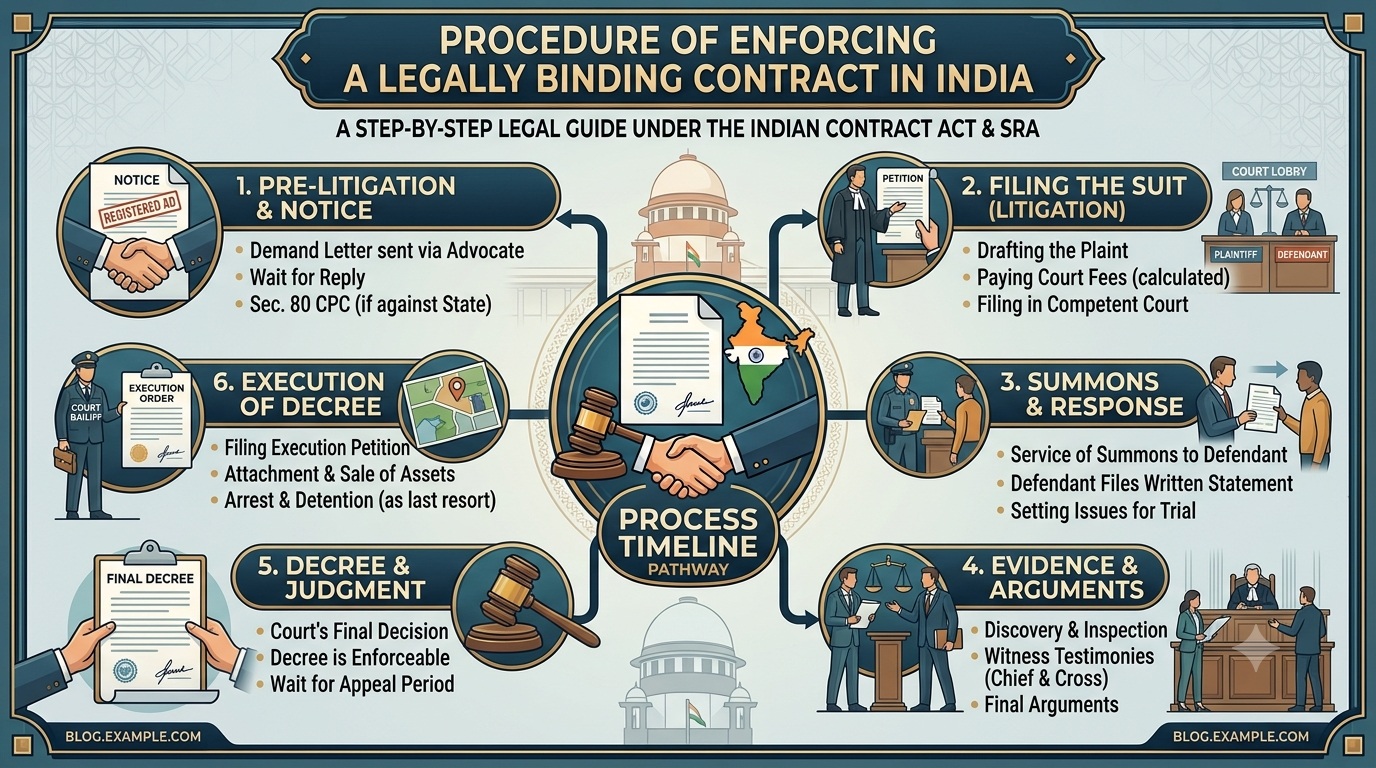
3. Legal Procedures for Enforcing Contracts:
Enforcing a contract in India can follow multiple pathways, depending on the nature of the contract and the preferences of the involved parties. Below are some of the most common procedures:
- Filing a Suit for Breach of Contract:
If a breach of contract occurs, the aggrieved party can file a suit in a civil court. Here’s the typical process:
Filing a Complaint: The aggrieved party (plaintiff) files a complaint detailing the breach, damages sought, and relevant documentation.
Serving Notice: A legal notice is sent to the defendant, providing them with an opportunity to respond.
Court Hearings and Evidence: Both parties present evidence, witnesses, and arguments. The court examines the validity of the contract, the breach, and the appropriate remedy.
Judgment and Relief: Based on the merits of the case, the court may order remedies such as compensation, specific performance, or rescission of the contract.
- Seeking Specific Performance
Under the Specific Relief Act, 1963, parties can seek a court-ordered specific performance of the contract, compelling the breaching party to fulfil their contractual obligations. Specific performance is commonly sought in contracts involving unique items or assets, such as real estate transactions. Courts may, however, deny specific performance if monetary damages are deemed sufficient to compensate the non-breaching party.
- Opting for Arbitration or Mediation
Arbitration and mediation offer an alternative to lengthy court procedures, providing a faster route to contract enforcement:
Arbitration: If a contract contains an arbitration clause, parties can resolve disputes through arbitration. Arbitrators issue binding decisions, making it an efficient choice for businesses. Indian courts generally uphold arbitration awards unless they contradict public policy.
Mediation: Mediation is a voluntary process where a neutral third party helps both sides reach an amicable resolution. While non-binding, mediation can be cost-effective and fosters collaboration.
- Summary Suits for Quick Relief
In clear-cut cases of unpaid debts or defaults, plaintiffs can file a summary suit under Order 37 of the Civil Procedure Code. This process bypasses lengthy trials, allowing courts to enforce contracts quickly if the defendant has no credible defense. Summary suits are common in cases involving loans, leases, and unpaid invoices.
4. Challenges in Enforcing Contracts in India:
Contract enforcement in India, while straightforward on paper, can encounter numerous practical challenges:
- Judicial Delays and Backlogs
Indian courts are well known for case backlogs, leading to prolonged timelines for resolving disputes. On average, civil cases can take years to reach a final resolution, straining resources and patience for all parties involved.
- Complexity in Serving Legal Notices
The process of serving legal notices and summons, particularly if parties are based in different jurisdictions, can be complex and time-consuming. This often leads to further delays, especially if defendants actively avoid receiving notices.
- Enforcement of Arbitration Awards
Despite India’s favourable stance on arbitration, enforcing arbitration awards can sometimes be problematic. Defendants may challenge awards on grounds of public policy or procedural flaws, leading to additional delays in contract enforcement.
- Limited Access to Summary Procedures
While summary suits offer faster resolutions, they are limited to certain types of contracts and cannot be used for all breaches. Additionally, defendants can still challenge summary suits, leading to protracted litigation.
- Infrastructure and Legal Costs
The high cost of legal services and the lack of adequate infrastructure in lower courts can deter parties from seeking enforcement through litigation. This is particularly challenging for small businesses with limited financial resources.
5. Best Practices for Effective Contract Enforcement:
Implementing proactive strategies and adhering to best practices can significantly ease the process of enforcing contracts. Here are some effective approaches:
- Draft Clear and Comprehensive Contracts
A well-drafted contract is the foundation of effective enforcement. Ensure that each clause is clearly defined, including the scope of work, payment terms, deadlines, and dispute resolution mechanisms. Ambiguities in language or terms can create loopholes, making it harder to enforce the contract if disputes arise.
- Include a Robust Dispute Resolution Clause
Incorporate a dispute resolution clause in the contract, specifying the preferred method, be it litigation, arbitration, or mediation. This clause should outline the governing jurisdiction and the process to be followed in case of a breach. Including an arbitration clause can expedite dispute resolution, while a mediation clause can be useful for less adversarial disputes.
- Send Well-Documented Legal Notices
In the event of a breach, sending a formal legal notice is crucial. Ensure the notice is clear, specific, and supported by relevant documentation. Legal notices often prompt out-of-court settlements or pre-empt further dispute resolution steps.
- Regularly Review and Update Contracts
Contracts should be reviewed and updated periodically to reflect changes in business terms, legal requirements, or market conditions. An outdated contract can be harder to enforce and may lack clauses relevant to emerging legal standards or business practices.
- Leverage Technology for Efficiency
Using digital contract management platforms can help streamline document storage, tracking, and retrieval. These platforms allow for secure e-signatures and automated reminders for renewals or actions, improving the enforceability of contracts by ensuring that all documentation is in order.
- Conduct Due Diligence Before Entering Contracts
Conduct background checks on potential business partners to assess their reliability and financial standing. Knowing the other party’s reputation and resources can prevent future issues, as reliable parties are more likely to honour their commitments and cooperate in case of disagreements.
6. Future Trends and Improvements in Contract Enforcement:
India’s contract enforcement environment is evolving. As reforms are implemented to reduce court backlogs and enhance arbitration infrastructure, the process of enforcing contracts should become more efficient.
- Digitization of Court Proceedings: The Indian judiciary is increasingly adopting technology to manage cases and facilitate virtual hearings, a trend that gained momentum during the COVID-19 pandemic.
- Increased Use of Online Dispute Resolution (ODR): ODR platforms are emerging as viable solutions for contract disputes, enabling parties to resolve issues online without traditional court procedures.
- Simplified Arbitration Processes: With the continued support of arbitration by Indian courts, simplification of the arbitration process is likely, with quicker enforcement of awards and reduced court interference.
Therefore, enforcing contracts in India involves navigating complex legal procedures, addressing common challenges, and employing best practices to ensure favourable outcomes. By understanding the legal framework, proactively drafting contracts with clear terms, and choosing appropriate dispute resolution methods, businesses can safeguard their interests and ensure enforceability. Though challenges persist, recent improvements and future legal reforms promise to make contract enforcement in India more efficient, offering parties greater security and encouraging smoother business transactions.