
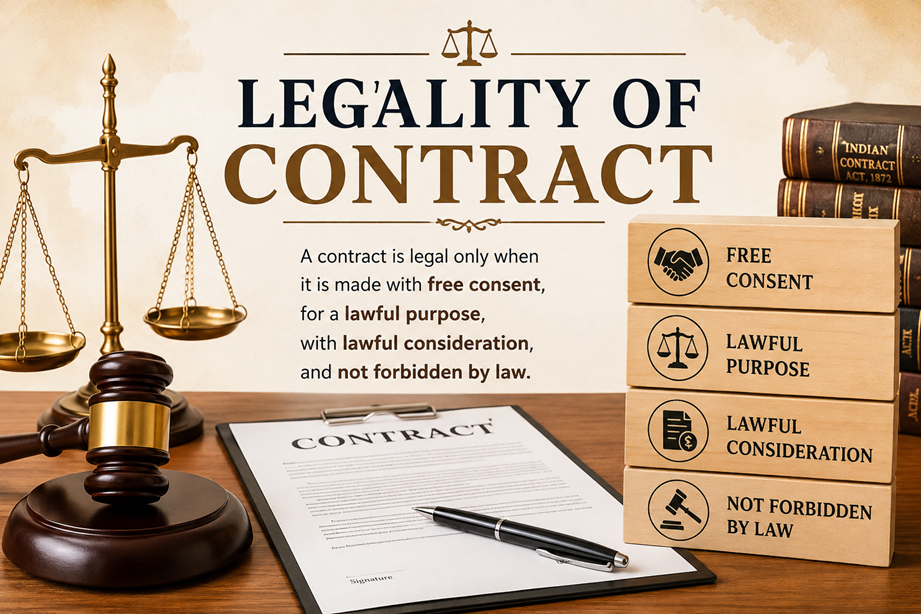
LEGALITY AS AN ESSENTIAL ELEMENT OF A CONTRACT
Legality is a core requirement meaning a contract must have a lawful purpose and object. An agreement fails this element if it breaks the law, involves prohibited acts, or goes against public policy. The object or thing which is under the contract or the object which is contracted must be legal or it must not be under disapproval category in terms of law.
If a contract contains language that violates any laws or regulations, then that contract isn’t legally binding for either party. It doesn’t matter who signed — it’s simply not a valid agreement.
Ensuring legality protects organizations from entering unenforceable or damaging agreements.
Intention to Create Legal Relationship:
The parties must intend legal consequences. Social or domestic arrangements generally do not create contracts.
Lawful Consideration and Lawful Object:
The consideration or object of an agreement must be lawful within the meaning of Section 23 of the Act. An agreement made for an unlawful consideration or for an unlawful object is void. Where a company does an act which is ultra vires, no legal relationship or effect ensures therefore. Such an act is absolutely void and cannot be ratified even if all the shareholders agree. Legality (or a lawful object and purpose) must follow the law. If a contract asks people to do something illegal or harmful to society, courts will not enforce it.
Section 23 of The Indian Contract Act, 1872:
What considerations and objects are lawful, and what not.—The consideration or object of an agreement is lawful, unless—
it is forbidden by law; or
is of such a nature that if permitted, it would defeat the provisions of any law; or
is fraudulent ; or
involves or implies injury to the person or property of another; or
the Court regards it as immoral, or opposed to public policy.
In each of these cases, the consideration or object of an agreement is said to be unlawful. Every agreement of which the object or consideration is unlawful is void.
WHY IT MATTERS: Contracts to perform illegal acts are void and unenforceable. Courts will not enforce an illegal contract, treating it as void from the start. Legality requires the contract’s subject matter and purpose to comply with legal norms and public policy.
Example: A supply agreement for medical equipment complies with health and safety regulations, which satisfies the legality requirement.
Agreements involving prohibited goods or services, such as illegal drugs or unlicensed activities, fail this element.
Example: A husband promises to gift jewellery to his wife. Normally not enforceable.
But commercial agreements are presumed to create legal obligations.
WHAT KIND OF CONTRACT IS ILLEGAL? Any agreement that:
- Violates Public Policy: Agreements must be in line with federal, state, and local laws.
- Made Under Misleading Circumstances: This includes agreements made under duress (force) or based on fraud or deception.
- Involve Illegal Activities: Agreements cannot require either party to do something that is against the law.
- Party Lacks Capacity to Contract: Agreements cannot involve a minor, or person who is mentally unsound.
WHAT MAKES A CONTRACT LEGAL?
- Lawful Purpose: The main goal must not break any local or national laws.
- Lawful Consideration: The money, items, or services traded must be legal to own and exchange.
- Public Policy: The agreement must not go against basic public safety, fairness, or moral standards.
Examples of UNLAWFUL (Void) AGREEMENTS
- Crime: An agreement to pay someone to commit a theft or harm another person.
- Fraud: A deal made to cheat a third party or the government out of taxes.
- Restraint of Trade: Extreme rules that unfairly stop a person from working or running a business anywhere.