THE RISKS OF USING AI FOR COMMERCIAL CONTRACT DRAFTING
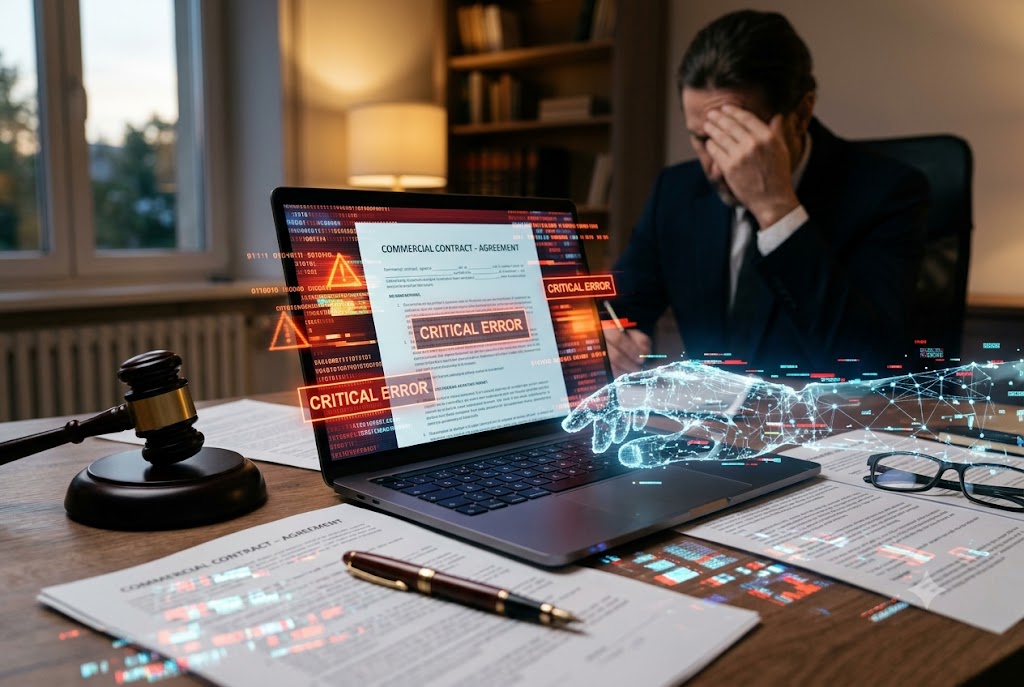
Artificial Intelligence (AI) has undeniably transformed the way we work, accelerating everything from copywriting to code generation. Unsurprisingly, many businesses like the idea of AI because it can save time and money. But using AI for important, binding contracts can be risky, and mistakes might lead to costly problems later.
While the promise of generating a 20-page Master Services Agreement in seconds is tempting, commercial contracts are the foundational bedrock of a business relationship. When things go wrong, every comma, definition, and clause is heavily scrutinised. Delegating this to an AI comes with significant risks that every business owner and legal professional should understand before hitting "GENERATE."
Here are the primary risks of relying too heavily on AI for commercial contract drafting.
1. Hallucinations and Inaccurate Precedents:
Large Language Models (LLMs) are predictive text engines; they are designed to sound confident, not necessarily to be factually accurate. In the legal realm, this phenomenon—known as "hallucinating"—can be disastrous. An AI might invent non-existent case law, cite repealed statutes, or stitch together boilerplate clauses from different jurisdictions that fundamentally contradict one another. A contract might look highly professional at first glance, but entirely fall apart under legal scrutiny.
2. The Context Void:
A commercial contract isn't just a collection of standard legal terms; it is a reflection of a specific business deal, relationship dynamics, and industry nuances. AI lacks the holistic, real-world context of the transaction. A contract is not just a collection of clauses. It is a strategic tool that statutes, case law, and industry norms shape.
Leverage and bargaining power - AI doesn't know if you are the dominant party dictating terms or the smaller vendor desperate for the deal.
Operational reality - AI doesn't know if a "30-day termination notice" is operationally feasible for your specific supply chain. Without understanding the commercial realities, AI cannot draft a contract that effectively protects your specific interests.
Lack of Accountability - AI providers usually disclaim responsibility for errors in their generated text. If an AI-drafted contract fails and you end up in court. Lawyers are accountable for the advice they provide or when drafting or reviewing a contract and are subject to ethical duties.
3. Inability to Negotiate or Strategize:
Contracts are outcomes of negotiation, not just documents. Good lawyers think about their power, expect the other side’s concerns, and carefully write terms to give the best protection. AI cannot negotiate with opposing counsel, assess bargaining positions, or advise on when to push back or concede.
4. Confidentiality and Data Privacy Breaches:
Drafting a custom contract often requires inputting sensitive information: pricing models, trade secrets, proprietary processes, and client identities. If you use public AI tools (like standard ChatGPT, Claude, or Gemini) without enterprise-level data protection agreements in place, you may inadvertently be feeding your company's most sensitive data into the model's training set. This could potentially violate existing NDAs or breach data privacy regulations like GDPR or CCPA.
5. Ambiguity and "Frankenstein" Contracts:
AI drafts by synthesising millions of documents it has ingested. Sometimes, it stitches together clauses that simply do not belong together, creating what lawyers call a "Frankenstein" contract. For example, an AI might include a clause mandating binding arbitration in one section, but include another clause allowing either party to litigate in a specific state court. Ambiguity is the enemy of a good contract, and AI-generated documents are frequently riddled with internal inconsistencies that invite expensive litigation.
6. Failure to Account for Jurisdictional Nuance:
Laws governing commercial contracts vary drastically depending on the state or country. A non-compete clause that is perfectly valid in one Uttarakhand might be completely void in Maharashtra. An AI might not properly weight the jurisdictional requirements of the governing law chosen for the contract, leaving you with unenforceable restrictive covenants, liability limitations, or indemnification clauses.
7. Real-World Consequences: When AI Gets It Wrong
The risks of using AI in legal contexts are not just theoretical; there are already several high-profile cases demonstrating the severe consequences of relying on AI hallucinations resulting in show of un-professionalism, misinformation, payment of damages and penalties, non-performance or non-compliance, termination of contract, unnecessary litigation, etc.
The Bottom Line: AI as an Assistant, not a Replacement:
Does this mean AI has no place in the legal department? Not at all. AI is an incredibly powerful tool for summarising long agreements, identifying missing standard clauses, or overcoming "blank page syndrome" by generating a very rough first outline.
However, AI should be viewed as an ambitious legal intern, not a seasoned partner. It requires strict supervision, rigorous fact-checking, and deep contextual review. When it comes to commercial contracts, the cost of getting it wrong far outweighs the time saved in drafting. For the foreseeable future, human judgment, business acumen, and legal expertise remain entirely irreplaceable.